Branded.
What are brands? Where did they come from? What do they mean in the context of sport?
First published on Medium
This text is a modified transcription of a podcast episode that was originally published on October 14, 2015 in audio format on Makers of Sport Podcast, the original of which can be found here along with its show notes.

Brands, what are they?
I am not sure many that use the word brand or branding really comprehend exactly what that word means. The term is often overused in today’s society—specifically in sports media. How often have you heard someone say “brand of football” or “they have a great brand”? What exactly does “brand of football” mean?
One of my biggest pet peeves is seeing a creative agency, in-house marketer or designer, or even freelancer saying they do “branding” and all they really do is create logos or images using the same color over and over with no consistency. It’s not too uncommon to hear a marketer or other salesperson to state “let’s get some branding on it” while referencing a design or creative project. I take this as their way of saying “make the logo bigger” and that without that logo, there is no “branding”. This line of thinking could not be more false. Allow me to explain.
First, we have to understand the origin of branding before drawing conclusions on what a brand is and isn’t. The American Marketing Association defines a brand as “a name, term, design, symbol, or any other feature that identifies one seller’s goods or service as distinct from those of other sellers. The legal term for brand is trademark. A brand may identify one item, a family of items, or all items of that seller. If used for the firm as a whole, the preferred term is trade name”.
That’s a generic and basic definition of what a brand is terms of marketing; but, in actuality and in the context of brands in today’s world, it goes much deeper than that. Often times a brand is described as a feeling. Jeff Bezos, the founder of Amazon, defines a brand as “what people say about you when you’re not in then room”. From that reference, one can understand that a brand is much more than a single product or a visual item such as a logo.
The late Wally Olins was one of the godfathers of branding, specifically as it related to corporate business. He was one of the co-founders of world-renowned branding firm, Wolff Olins, who defines brands as “a set of ideas a company or product stands for in people’s minds, shaped by that company or product’s actions and recognized through a visual and verbal style” as referenced in ‘[The Secret Power of Brands’, a class on branding at FutureLearn by Wolff Olins strategist, Robert Jones].
The Origin
Historically brands were a way to mark ownership of property. Think about it in cattle context—a rancher branded his or her cattle. Basically these watermarks, signatures, stamps or burned images were used to tell others that this particular item is their’s.
As time progressed and people began to contribute economically by creating services and products, brands were a way of making a promise to customers of quality so they would recognize and continue to purchase services or products from a particular supplier. People began to not only stamp recognizable marks on their property, but on the products they sold.
In the early days, perhaps products and foods were unsavory and/or untrustworthy as people went to market often affecting the purchasing experience, but having a brand meant something. There was something consistent about it. If you purchased the product and/or service and had a good experience with it, that experience caused you to trust in the product or service; hence when you needed it again, you would purchase from the same person because you remembered the experience from the last time and trusted that you would be provided with that quality experience again from the same person—or as growth of their business ensued, the same company. Therefore brands were a combination of quality & consistency of product or service, the customer experience, trust, as well as the visuals such as a logo or packaging.
“[a brand is] a set of ideas a company or product stands for in people’s minds, shaped by that company or product’s actions and recognized through a visual and verbal style”
As with anything that becomes successful though, there are copycats. So, what stopped others from stealing the visuals and pretending to be a company that was having success? Well, in the 1870s, registered trademarks were created in Europe as a way protect these company assets. Some of the earliest trademarks from a consumer brand perspective are still around today in Kellogg’s and Bass beer.
Now that we know historically where brands come from, we head back to the modern area. We can now determine that a brand is not only a visual asset such as a logo, but an experience—how a company, organization, product or organization makes people feel. And that feeling is influenced by the company or organization through their actions, be it customer service, quality product, consistent visuals and/or other actions. In other words, is the company doing things that make people feel like they can trust them? What do you think of when from a brand perspective when I mention Apple, Nike, Target or Mercedes-Benz? How about Dell? Monsanto? Facebook? Do you immediately consider whether you can trust these companies? Have their actions led to whether you can trust them or have you had quality and consistent experiences with them which led to current & future trust? What is your gut feeling when these companies are mentioned?
Branding in Sport
Now that we understand the basis of branding, let’s put all of this in the context of sports. Wins, traditions, coaching personalities, team personalities, facilities and viewing access (i.e. TV contracts, live-streaming, viewability) are all things that affect brands from the sports sense. In the case of college athletics, there are actually many brands within one athletic department. You have the brand of the entire athletic department, which acts as sort of as an umbrella brand. That is where the visual identity is influenced, created and policed. That visual identity is shared by all sports within the athletic department and remains unmodified. From a personnel perspective, perhaps the athletic department has gained a trust in the fan base and in future recruits for delivering on a promise of great facilities, quality resources in regards to alumni donations, or a track record of success in regards to former athletes, personnel and hires.
Next, we can delve deeper into an athletic department to see that not only do you have the overarching brand, but you have individual team brands; each with their own coaching personalities. Often these are referred to as “the program” (i.e. the football program or basketball program).
“The program” is a deeper dive into a specific college athletics individual sporting system and can have many different things influencing its brand. Possibly, it’s the culmination of many years of winning history (i.e. Notre Dame, Ohio State and Alabama football). Possibly, no winning history at all (i.e. Kentucky & Vanderbilt football). It could also be that a particular program is brand new and has no history. Maybe it’s uniforms and the on-field visual identity (i.e. Oregon football) that make a program stand out. There might even be a negative stigma surrounding a program due to select personnel and their past actions (i.e. Baylor football).
Regardless, many factors affect the brand of individual sport programs and for this reason, programs that know how to successfully leverage that brand will always be more successful than others.
Determining an Athletic Brand’s Value
In the college athletics space, we often hear the terms “football school” or “basketball school” thrown around in which case, most likely the football or basketball program is the most valuable brand within the entire athletic department due in part to wins on the field or court, merchandise sales, revenue, post-college success (i.e. producing draft picks), fan loyalty and casual viewer or fan recognition. The assumption though tends to be that money is a leading factor in whether a brand is successful in sports. I’d argue that this is a wrong assumption. Many will assume that a “basketball school” must not be successful from a revenue perspective in football when in reality, revenue doesn’t matter in regards to if a school is a football school or basketball school. I’ll take for example my own beloved Kentucky Wildcats. From a revenue perspective, one could argue that Kentucky is a football school. The football program dwarfs all other athletic programs in revenue mostly in part to their relationship with the Southeastern Conference (which in regards to its own brand is known as a football conference). The SEC has become synonymous for cheering for an entire conference rather than wanting your hated conference rivals to lose if they happen to make it on the national stage. Non-SEC fans hate it; however, from a business perspective, it makes complete sense to root for your entire conference, simply because if one of your conference teams wins the national championship, then millions of television and sponsorship dollars are split amongst conference schools. This is why conferences are so important in college sports and also why we see conferences with their own television networks like the SEC Network and Big Ten Network.
Back to the University of Kentucky though, as many of you that pay attention to college sports know, the men’s basketball program is much more successful than any other sport, but because college football is such a large entity revenue wise, it does not come close to football in terms of revenue, yet it is still known as a basketball school. An interesting scenario that makes a decent argument that money in college sports, doesn’t really influence a brand as much as maybe other industries.
Team Brand Equity
Staying in the same vein as it regards to each sport having it’s own brand within an athletic department, each team (on a yearly basis) itself has a brand. Most often the team’s brand is reflective on the coaching staff’s personality, but the personnel on a team can influence it as well. In the professional sports sense, think about the Detroit Pistons’ “Bad Boys”, the Jordan & Pippen Chicago Bulls, the Dallas Cowboys of the 90s, or this past season’s Chicago Cubs.
In Kentucky’s case, the reason why fans are so passionate about Kentucky basketball (even though hardly any players on the team are from the state itself due to the modern era’s recruiting landscape) is because many years ago, fans appreciated Adolph Rupp, Joe B. Hall and even Rick Pitino going into the mountains and rural areas of the state and picking up players from the local high schools. The coal miners, farmers and small-town folks who struggled in daily life had someone, their local star basketball player, who was maybe a co-worker or family member’s son, to cheer for and put on a pedestal. That person represented them, where they are from. Then of course because of the team context, Kentucky (the state school) now represented not only their local hero, but them as well. Fans saw it as a way to beat the hillbilly stereotype. In other words, the world may be better than them in most aspects of life, but basketball is where they could be equal or in some cases feel superior.
In today’s John Calipari era though, an era in which the basketball teams have become much more known for a big city swagger (think John Wall dancing before games or Anthony Davis blocking shots and pointing at the crowd) rather than a small-town blue collar attitude, why have fans continued to remain so loyal?
This is where brand equity comes into play. When people begin to trust something or someone, they are putting an inherent value in that thing. That thing becomes ingrained in them. It becomes something that they care about. As I mentioned earlier, when trust is built over time, people will return to the thing that has given them quality experiences because based on the history, those experiences will remain quality for future years to come. At least that is what we hope for.
Brands & Perception
Just as consumer brands can influence people through perception, almost at a subconscious level, so too can sports brands. For example, in 2015 ESPN’s Heather Dinich wrote an article about brands and the College Football Playoff. In it, she discusses how a brand name can influence the College Football Playoff committee in regards to putting a team in the playoffs. For example, if a choice comes down to Ohio State and Utah, it is almost easier for people to think about the long-term brand of Ohio State football and put weight on that choice. Oklahoma coach Bob Stoops is even quoted in the article saying “brand recognition usually matters. If all things are equal, sometimes you go with what is most familiar or what you know”.
Is choosing the College Football Playoff participants based on branding the right way to make those selections? Of course not. But, this is why branding and marketing are so important when it comes to sports.
The Importance of Color in Sport
Those of you that listen to Makers of Sport know that most of my knowledge and focus is on sports in the U.S.; however, as someone that is not privy to rugby, I am well aware of the New Zealand All Blacks. The fact that someone not privy to the sport knows about the team, means that they have a great and recognizable brand. Having a brand that not only your own fans love and recognize but is recognizable to non-fans (even non-fans of your sport) is just as important.
In regards to All Blacks brand, I know that it is a brand that intimidates opponents. Partly because of their pre-game ritual known as the Haka, an ancestral war cry dance of the people of New Zealand.
Off the top of my head, I don’t even know what the All Blacks logo looks like, but I do know that they have a reputation of being a big strong, mean looking, aggressive athletes wearing black uniforms. This is where one could argue that color is perhaps the most important thing when it comes to a visual identity, more so than the logo itself.
A colleague of mine that was once a managing director of Ogilvy Worldwide, and worked on the award-winning Dove ‘Real Beauty’ campaigns, once told me over lunch that “a brand is a name, I color, and a personality”. This particular gentleman has made a name for himself in the niche of beauty products and he consults today worldwide with brands in that category around the globe. It should be noted that this gentleman does not actually provide logo design services at all. Yet he refers to himself as a brand consultant. How telling is that that branding isn’t about logos?
The Anti-Brand
In some instances, perhaps a brand is having no brand at all. For example, what is the brand of University of Oregon football?
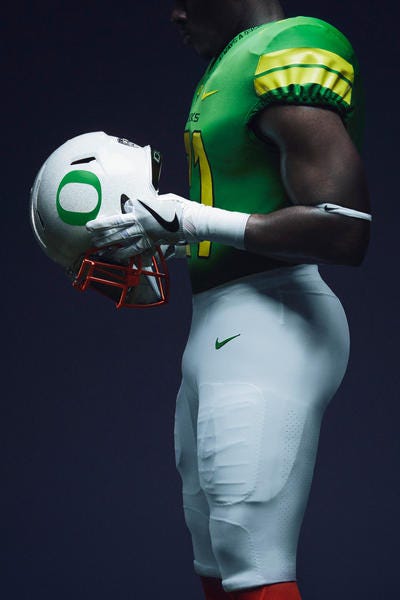
On the field it’s a definitely fast-paced, high-scoring style of play; but as far as what they wear, it pretty much has no brand. Through it’s partnership with Nike, the Oregon Ducks football team changes their uniforms significantly for every single football game. As a die-hard University of Oregon supporter and alumnus, Nike co-founder Phil Knight wanted to put his alma mater on the map in the college football game. The problem was, it had no real history in the sport in regards to wins and tradition. How does one build a brand in a world of traditional and successful brands? Their solution? They embraced not having a brand became the anti-brand. They could come up with whatever gimmicks they wanted from a visual perspective and play into recruits’ growing interest in things like on-field uniforms, sneakers, merchandise and fashion. This method of being an anti-brand has obviously worked well as rural Eugene, Oregon has turned into a national football powerhouse pulling recruits from all over the country due to their uniforms and incredible state-of-the-art, modern facilities.
Closing
In closing, what does this all really mean for us? Those of us who are creatives or marketers working in sports? Well for one, it means that we shouldn’t just critic new sports uniforms and branding for subjective reasons. It also means that just because you don’t create brand identities, it doesn’t mean you aren’t creating brands. For example, creating a poster campaign, social campaign and overall visual language for a team’s season is just as much as creating a brand as an identity designer creating a visual identity for an organization. In that instance you are creating the brand’s visual assets and a consistent style for that team and that season. Those visuals help to stamp a specific place in time and history for an individual season and team.
As you continue to grow as a creative person, I recommend studying the work of Wally Olins mentioned earlier, his philosophies and methods; as well as studying the timeless consumer brands such as Coca-Cola and Harley Davidson. Pay attention to how even though they may change things visually over time, from a birds eye view they remain consistent aesthetically and deliver their message of trust though visual and strategic methods. If you are interested in diving deep into brands in sport, look at more than the execution of logos from an illustrative and typographic standpoint, but really understand why decisions made and how they tie in strategically to a team’s history or the message they are trying to get across.
Makers of Sport is a podcast about the intersection of creativity and sports. The show includes interviews with designers, art directors, writers, animators, sneakerologists, marketers, technologists and entrepreneurs working in the sports vertical. To listen to the podcast, subscribe on iTunes or play on Soundcloud. Subsequently, the Makers of Sport Community is available to join for a small monthly fee and includes additional educational content, private Q&As, extra soundbites, private podcasts and more.